
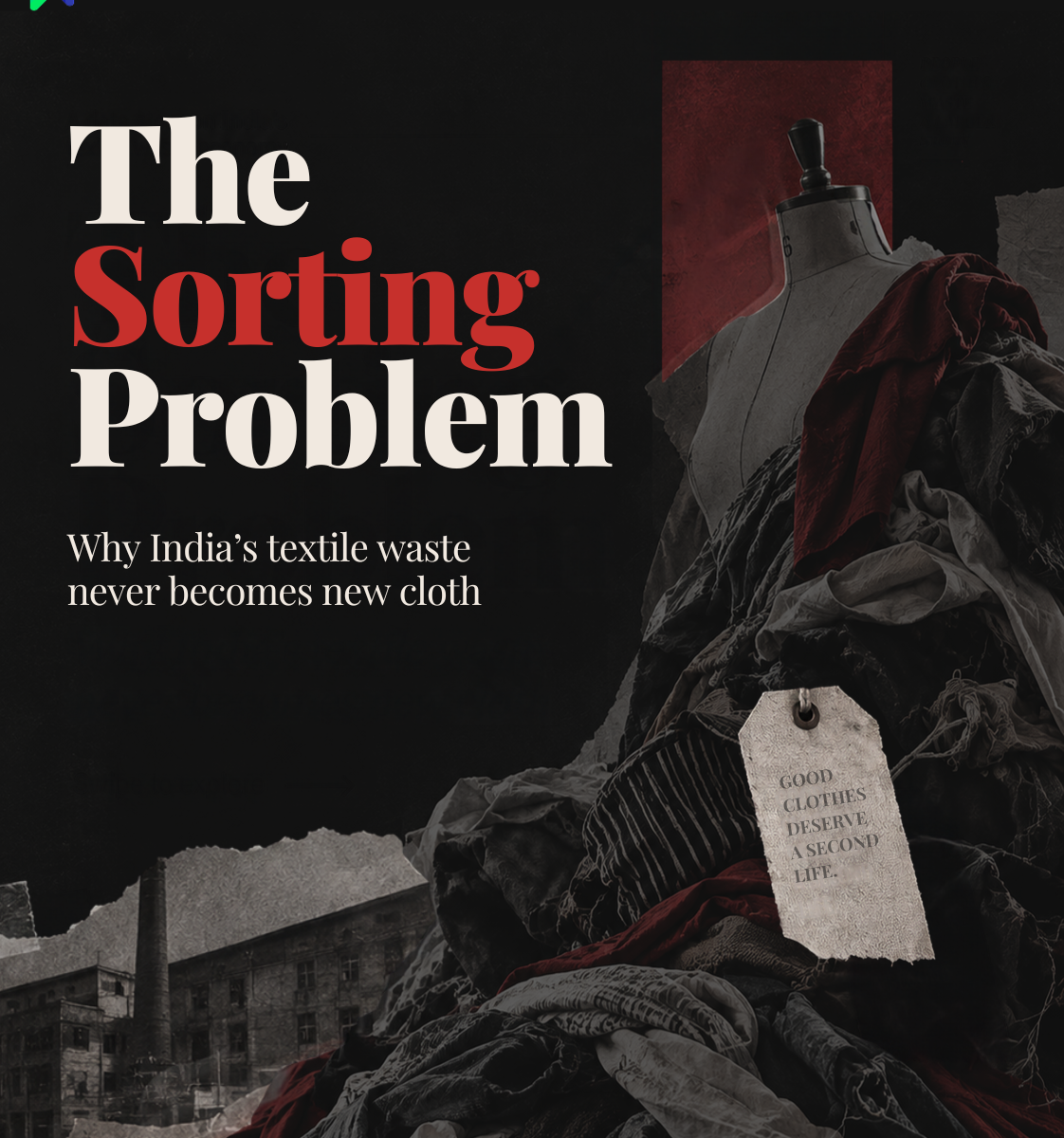
Why India’s Textile Waste Never Becomes New Cloth
India throws away 7 million tonnes of clothes and fabric scraps every year. Almost none of it comes back as new fabric, and the reason has nothing to do with technology.
Here’s a number that sounds like good news until you sit with it: India recovers 97% of the fabric scraps its garment factories throw away. Almost no other waste stream in the country does that well. Plastic doesn’t. E-waste doesn’t.
But “recovered” is doing a lot of quiet work in that sentence. It doesn’t mean recycled into new fabric. Much of that 97% ends up as mattress stuffing, pillow filling, and cheap wipes — materials that leave the textile economy and never come back. Less than 1% of everything India throws away, factory scraps and old clothes combined, is turned back into fiber fit for a new garment.
This isn’t a story about India lacking recycling machines, or Indians not caring enough to sort their trash. It’s a story about money, about who pays for sorting, who profits from it, and why, right now, almost nobody does either. Once you see the economics, the whole picture stops looking like carelessness and starts looking like a system running exactly the way its incentives were built to run.
1. The number that hides the real story
2. Why good cotton ends up as stuffing
3. The economics nobody talks about
4. It’s not just India, the same gap, worldwide
5. The one rule that could fix it (and why it doesn’t exist yet)
1. The number that hides the real story
India’s textile and apparel industry is enormous, the second-largest employer in the country after agriculture, supporting roughly 4.5 crore people, and contributing close to 2% of GDP. An industry that size produces waste at scale: 7,073 kilotonnes a year, according to a Ministry of Textiles mapping exercise published earlier this year. That’s more than plastic waste generates in some estimates, yet textile waste has no dedicated regulation, no rulebook, no targets, nothing like what exists for plastic or e-waste.
Of that total, roughly 42% is pre-consumer waste, offcuts, rejects, and scraps generated while making clothes, before they ever reach a shopper. The rest, 58%, is post-consumer: clothes that have actually been worn and thrown away.
The government’s headline stat on pre-consumer waste is that 97% gets “recovered” rather than landfilled. It’s a genuinely strong number by global standards, where only 12–15% of textile waste globally reaches any kind of recycling facility. But recovery isn’t recycling. Of that 97%, roughly 1,000 kilotonnes a year, nearly two-fifths of everything factories discard — ends up as stuffing and filler. That material is gone from the textile supply chain permanently. It’s not coming back as a shirt.
2. Why good cotton ends up as stuffing
Here’s the part that should bother you more than the headline stat: a meaningful chunk of that stuffing pile isn’t hard-to-recycle material. It’s clean, single-fiber cotton, the easiest kind of fabric waste to turn back into usable yarn.
The reason it gets downcycled anyway comes down to how it’s sold. Factories don’t sell their scraps sorted by fiber type. They sell them mixed, one bulk bag containing ten different fabrics, cotton sitting next to poly-blends, no separation. The moment good cotton shares a bag with a cheap synthetic blend, the buyer has no way to price them separately. The whole bag gets valued, and processed, as low-grade mixed waste.
This isn’t a technical failure. Machines exist that can shred and respin single-fiber cotton into decent yarn. What doesn’t exist is a reason for anyone in the chain to keep that cotton separate in the first place.
3. The economics nobody talks about
This is the actual crux of the problem, and it’s simpler than it sounds: sorting costs money at one end of the chain, and the payoff shows up at a completely different end.
A factory would have to pay, in labor, time, and process, to separate its cotton scraps from its polyester scraps. But the benefit of that sorting, cleaner fiber, a higher resale price, a shot at real fiber-to-fiber recycling instead of downcycling, is captured further down the chain, by a buyer, a recycler, or a brand who eventually gets cleaner material to work with. The factory bears the cost. Somebody else gets the value.
In a functioning market, prices would fix this automatically, buyers would pay a premium for sorted, single-fiber material, and that premium would eventually make sorting worth the factory’s while. But that premium barely exists here, because there’s no reliable demand for recycled textile fiber at scale, no standard that certifies what’s inside a sorted bale, and no requirement anywhere in the chain that forces a buyer to care. Without a price signal, “not doing it” is simply the cheaper option. Every single time.
4. It’s not just India, the same gap, worldwide
If this sounds like a distinctly Indian problem, it isn’t. It’s close to a universal one.
Globally, the Ellen MacArthur Foundation has tracked this exact gap: of the textile waste that actually gets collected for recycling worldwide, only about 12% is downcycled into things like insulation, and less than 1% is turned back into fiber for new clothing in anything resembling a closed loop. That’s the same shape as India’s own numbers, a system that “handles” waste without meaningfully recycling it.
A 2024 mapping project across six European countries, Belgium, Germany, the Netherlands, Poland, Spain, and the UK, put a number on exactly what’s being left on the table. Researchers found that a huge share of low-value post-consumer textiles, around half a million tonnes, was readily suitable for fiber-to-fiber recycling, but was never sorted well enough to reach it. They estimated the value sitting unclaimed in that unsorted material at close to €74 million a year, in six countries alone.
Different economy, different regulatory environment, richer consumers, better-funded recycling infrastructure, and the exact same failure. Good material, sitting there, un-sorted, because nobody along the chain had a financial reason to sort it. That should tell you something: this isn’t a poverty problem or an India-specific infrastructure gap. It’s what happens by default, everywhere, when no one owns the cost of sorting.
5. The one rule that could fix it (and why it doesn’t exist yet)
Compare textiles to plastic for a second. Rigid plastic packaging sold in India is now legally required to contain a minimum share of recycled material, 40% today, rising to 60% by 2028-29. E-waste has recycling targets tied directly to what a producer sells. Both of these run on a framework called Extended Producer Responsibility (EPR), which keeps a brand financially on the hook for what happens to its product after it’s sold.
EPR is, bluntly, the only reason anyone bothers sorting anything at scale. A company invests in separating its waste when someone downstream is required to buy clean material and is legally on the hook for hitting a target. Textiles have no equivalent. No brand in India is required to put a single gram of recycled fiber into a garment. Which means nothing, anywhere upstream, creates a reason to keep good cotton out of the stuffing pile.
There’s no textile EPR notified, no draft in the gazette, no consultation paper from a pollution control board, despite virtually every major industry report over the past year asking for one. The gaps run deeper than that, too: there’s no tax code (HSN code) in India that even distinguishes recycled textile fiber from virgin fiber, so recycled yarn has no formal identity in trade. Manufacturers can’t claim incentives for using it. The government can’t mandate it in procurement, because the system literally cannot see the difference on paper.
And the one rule that did just change points the wrong way. India’s Solid Waste Management Rules, effective from April 2026, raise the mandatory share of waste that cement kilns and waste-to-energy plants must burn as fuel, including textiles, from 5% to 15% over six years. Read plainly: the newest waste law in the country creates growing, legally mandated demand for old clothes as fuel, and offers no equivalent pathway for turning them back into material.
What’s in it for you
If you’re a consumer, the most useful thing you can do is also the cheapest: sort before you sell or toss. Clothes and fabric handed over clean, dry, and separated from other waste can be reused or recycled roughly three times more often than the same items mixed in with regular trash. This single habit, barely a few seconds of effort, is currently the single biggest lever available to any individual, because it works around the exact bottleneck this article describes: contamination and mixing.
If you’re in the industry, a brand, a factory, a sourcing manager, this is worth reading as an economics problem before it’s read as a sustainability one. The businesses actually making progress here (closed-loop denim programs, factories running mechanical recycling for global sportswear brands) succeed because they’ve built a private version of what EPR would eventually mandate: a direct, priced relationship between sorted, cleaner material and someone willing to pay more for it. That model is replicable well before any law forces it.
If you’re a policymaker or investor, the gap itself is the opportunity. The absence of a grading standard, an HSN code, and financing infrastructure for sorting facilities isn’t a dead end, it’s a market waiting for whoever builds the first piece of it, because once bales carry verified, standardized documentation of what’s inside them, banks and buyers who currently won’t touch this sector suddenly can.
Disclamer- This content is for informational and educational purposes only and does not constitute investment, legal, or tax advice. Please consult qualified professionals before making any financial decisions. MintWit Financial Services LLP is an AMFI-registered Mutual Fund Distributor (ARN-283168); however, all investments are subject to market risks and returns are not assured.
