
Fine art has stored wealth across civilisations. What changed is that someone started building the data to prove it, and that data is now pointing firmly at India.
September 2025. A single evening auction in New Delhi. Eighty-five paintings go under the hammer. Every single one sells. Total: rupees 355.77 crore in one night, the highest value ever recorded for a South Asian art auction, anywhere in the world. The highlight was a 1970 abstract painting by V.S. Gaitonde, a quiet, reclusive artist from Goa who barely spoke in interviews and spent years staring at the sea outside his Bombay studio. His untitled yellow-ochre canvas sold for rupees 67.08 crore, nearly three times its estimate, to a room of bidders who drove the price up past every number the auction house had projected.

That night at Saffronart’s 25th anniversary auction was not a freak event. It was the loudest signal yet in a market that has been building steadily for two decades, a market where Indian art is no longer just a cultural possession but a serious, globally recognised financial asset. And for investors paying attention, the question is no longer whether art belongs in a portfolio. It’s how to think about it properly.
This newsletter covers the full picture: what makes art valuable, what it has historically returned, the different ways to invest, how India’s market has evolved year by year, and what a new generation of collectors is doing differently from their parents.
1. Why a Painting Has a Price
Unlike a share of stock, a painting has no earnings, no dividends, and no quarterly report. Its price is set by a different and more human set of forces, ones that have operated the same way since the Medici family of Renaissance Florence used art to signal power and preserve wealth across generations. Understanding these forces is the foundation of any serious art investment thesis.
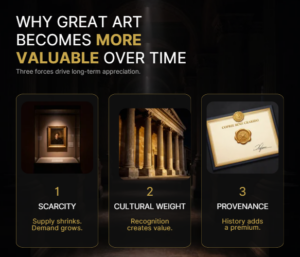
These three forces make art behave differently from almost every financial instrument. When equity markets fell sharply in 2008, Christie’s, the world’s largest auction house, founded in London in 1766 and handling over $7 billion in sales annually, observed that auction volumes didn’t collapse because of falling demand. They fell because sellers chose not to sell into a distressed market. They simply waited. That option doesn’t exist with stocks. This is the structural feature that draws serious long-term capital to art: it does not panic.
2. What Art Has Actually Returned
The most important thing to understand about art return data is that it is not one number. It depends entirely on which segment you are looking at and how long you held.
The most honest measure comes from the Mei Moses index, built by economists who tracked the same artwork selling at auction twice and calculated what it actually returned between those two sales. Across more than 40,000 such paired transactions going back to 1875, the average annual return is 6.5–6.7%. No cherry-picking, no selection bias, just what paintings returned to the people who held them. The Artprice100, which tracks the world’s 100 most traded artists, tells a higher story: 8.9% annually over 20 years. Contemporary art specifically, artists who are still living and whose market is actively building, returned 11.5% annually between 1995 and 2023 according to Artprice data.
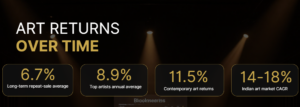
The gap between Mei Moses (6.7%) and Artprice100 (8.9%) is not a contradiction. It is the selection premium, the extra return you earn by holding the right artists for long enough. Earning it requires genuine knowledge, patience, and the willingness to sit on an illiquid asset for years. For India specifically, the 14–18% CAGR figure covers the entire Indian art auction market over 37 years, not just the trophy lots, but the broad ecosystem. That sustained growth rate is what makes India a structurally different proposition from the global art market.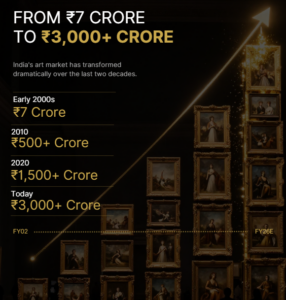
Two things stand out in this chart. First, the 2020–2021 COVID period didn’t crush the market, it accelerated it. Collectors, confined at home, discovered digital auction platforms and spent on what they could still acquire and enjoy. Saffronart reported selling four times as much art in the first year of the pandemic as the year before. Second, September 2025 alone generated rupees 865.8 crore in auction turnover, a single month that surpassed the entire annual turnover of the Indian art market in any year before 2021. That is the pace of the current momentum.
3. How You Actually Build an Art Position
The idea that art investing requires a nine-figure net worth and a personal connection is outdated. The entry points have multiplied. But each route is genuinely different, in how much it costs, how much knowledge it demands, and what your relationship with the work actually is.
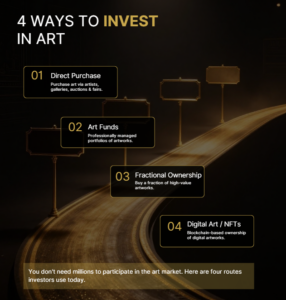
Whichever route you choose, five things determine whether an art investment actually works, or costs you more than you made:
1. Authentication
Forgeries exist at every price point. Before buying artwork above ₹10 lakh, obtain an independent expert opinion, verify the certificate of authenticity, and check the provenance chain. The cost of authentication is small compared to the risk of buying a fake.
2. The Full Cost of Owning Art
Your auction bid is not your final cost. Add buyer’s premium, insurance, GST, storage, conservation, and eventually the seller’s commission when you exit. Published returns are gross returns; actual net returns are lower after these expenses.
3. Liquidity- You Cannot Exit on Demand
Art is an illiquid asset. You must wait for the right auction window, the right buyers, and acceptable market conditions. If you may need access to your capital within the next few years, art may not be the ideal allocation.
4. Which Artists to Buy
Focus on artists with proven staying power. Limited supply, institutional recognition, and a deep collector base tend to support long-term value. Emerging artists can generate strong returns, but they also carry significantly higher risk.
4. A Decade of Records That Are Not Slowing Down
India’s art market has had its best sustained run in recorded history over the past three years. The numbers are not anecdotal, they are consistent across auction houses, price segments, and geographies. In 2024, while the global art market contracted 12%, India’s grew 19%. In September 2025, a single month’s auction activity generated more turnover than the entire Indian art market’s annual total in any year before 2021. The entry price to be in the top 10 artists rose 287% between 2021 and 2024 alone, from rupees 1.99 crore to rupees 7.70 crore per work.
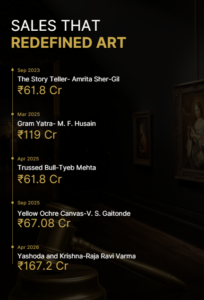
Two policy changes have accelerated this further. The GST on fine art purchases was cut from 12% to 5% in September 2025, giving every domestic buyer a 700 basis point cost advantage they immediately began factoring into their acquisition budgets. And India Art Fair’s 2026 edition saw 123 exhibitors across 12 cities, double the number of art events in 2023. The infrastructure of collecting, galleries, fairs, digital platforms, auction houses, is expanding as fast as the wealth base that feeds it.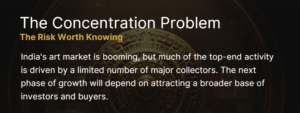
5. What Changes When a Generation Discovers Art on Instagram
The collector of 2026 found their first artist on Instagram, bid at their first auction on a phone, and thinks about collecting the way their parents thought about mutual funds, as something that builds over time with regular, considered additions. The data on this generational shift is significant.
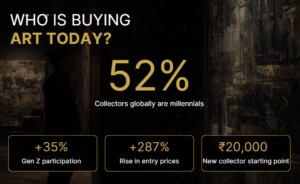
What’s changed is not just who is buying, but how they discover art. Instagram has made it possible for an artist in Jaipur to build a 50,000-follower collector base without ever showing at a Delhi gallery. Digital platforms like Artsy reported that Indian artists saw the largest surge in demand on their site globally in 2024. India Art Fair’s travel format, brought to hotel lobbies in Tier 2 cities by gallerist Payal Kapoor’s Artix fair, is reaching collectors who would never fly to an auction preview.
The market is also broadening beyond the established names. The 2024 Hurun India Art List found 27-year-old Raghav Babbar ranking 8th by sales value, alongside 99-year-old Krishen Khanna in 5th. The generation gap in the collector base is closing. Sales by the top 50 artists reached rupees 301 crore in 2024, a 19% increase over 2023, with 92% of listed artists seeing a rise in their sales value.

The honest note to end on: Instagram following is not the same as institutional recognition, and institutional recognition is what drives long-run price appreciation. The collectors who will look back on the 2020s as a great decade for Indian art buying will be those who chose artists the museums and critics eventually validated, not just the ones who were popular online at the time. The two categories overlap sometimes. Identifying which emerging artist will make that crossing requires genuine immersion in the field, not just an aesthetic preference. That knowledge, built over time, through exposure, through relationships with gallerists and critics, is itself the asset that compounds.
6. The Return That Lives on Your Wall
Art has stored wealth across civilisations not because it was a financial instrument, but because it was the one thing that combined beauty, scarcity, cultural permanence, and social prestige in a single object. What is new is the data, indices, auction records, market reports, that let us talk about it in the language of returns and asset allocation. That data, now consistently compiled over 37 years for India specifically, makes a clear case: the Indian art market has compounded at 14–18% annually, the top artists’ entry prices have nearly tripled in three years, and in September 2025, a single night’s auction set a global record for South Asian art.
For anyone thinking about whether art belongs in a portfolio, the answer the evidence gives is: yes, with conditions. Long time horizons. Genuine knowledge of what you are buying. Acceptance of illiquidity as a feature, not a bug. A clear-eyed accounting of every cost beyond the hammer price. And the understanding that the best art investment you can make is in your own taste, because the collector who buys what they genuinely love will hold through every market cycle, and holding is where the return actually lives.
Disclamer: This content is for informational and educational purposes only and does not constitute investment, legal, or tax advice. Please consult qualified professionals before making any financial decisions. MintWit Financial Services LLP is an AMFI-registered Mutual Fund Distributor (ARN-283168); however, all investments are subject to market risks and returns are not assured.