
In our last month’s issue, we examined India’s Data Centre Revolution, how Budget 2026 unlocked $90 billion in commitments, and why India is positioning itself as a global cloud infrastructure hub. This week, we take that story one step further, from asking where data centres are being built, to asking whether they should be built on Earth at all.
The world is running out of power, water, and land to feed AI’s hunger for computing. A quiet race is underway, led by SpaceX, Google, China, and a new wave of startups, to move that computing into orbit.
This edition of The Mint Edge maps the structural forces driving that shift: the energy crisis that is making Earth-based compute economically untenable, the economics of orbital power that changes the cost curve entirely, the constellation infrastructure compounding across the US, China, and Europe, and what the data says about where the first commercial viability window is likely to open.
1. Why Ground-Based Data Centres Are Struggling- the physics of the problem
2. What a Space Data Centre Actually Is- the concept, plainly explained
3. The Case for Orbit- solar power, zero water, and unlimited scale
4. The Global Race- who is building what, and how fast
5. What Could Go Wrong- latency, debris, and the maintenance problem
6. What This Means for You- why this matters to the Indian investor today
1. Why Ground-Based Data Centres Are Struggling
Every time you use an AI tool, to draft an email, analyse a document, or generate an image, somewhere, a warehouse full of computers does the work. These warehouses are called data centres, and they have become the hidden infrastructure of the modern economy. They are quietly reaching their physical limits.
What is a data centre, exactly? Think of it as a very large, very cold room filled with thousands of specialised computers running 24 hours a day. Everything that lives “in the cloud”, your email, your streaming service, your company’s software, actually lives in one of these buildings. They require enormous amounts of electricity to run the computers, and equally enormous amounts of water to keep those computers cool.
The Nvidia H100 chip, the workhorse of AI training, draws 700 watts each. A single DGX H100 server holds eight of these chips, drawing around 10 kilowatts per server. At a standard deployment density of four servers per rack, a single AI rack draws upwards of ~40 kilowatts, versus 5–12 kilowatts for a traditional server rack. The result: a cutting-edge AI data centre draws as much power as a mid-sized Indian city.
Cooling towers consumed approximately 150 billion litres of water across India’s data centres in 2025, expected to reach 358 billion litres by 2030. In markets like Singapore, Ireland, and parts of the US, governments have imposed moratoria on new data centre construction because grids simply cannot absorb more load.
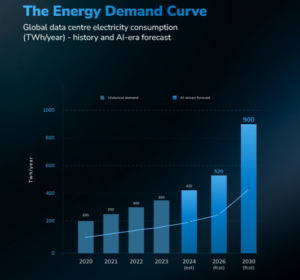
This is not a technology problem, it is a physics problem. The electricity grids and water tables that data centres depend on cannot keep pace with what AI demands. India committed $90 billion to data centre infrastructure last year and is already running into these very constraints.
2. What a Space Data Centre Actually Is
The idea is exactly what it sounds like: a data centre, servers, storage, computing chips, built not in a building on Earth, but on a satellite in Low Earth Orbit (LEO), roughly 300 to 600 kilometres above the surface, the altitude at which the International Space Station has operated for over two decades.
Why LEO specifically? Low Earth Orbit is close enough to Earth that data can travel back and forth quickly, crucial for practical use. It is also far enough that gravity does not pull satellites down immediately; they can maintain orbit for years. Constellations like Starlink and GPS already prove that hundreds of satellites at this altitude can work reliably together.
The architecture mirrors a terrestrial data centre: the same processors and GPUs, memory and storage, networking logic, just mounted on a satellite chassis. What changes entirely is the operating environment. In orbit there is no weather, no land to acquire, no planning authority to navigate. Solar panels collect sunlight that is on average up to 35% more intense in space than at Earth’s surface (with no atmosphere to absorb or scatter it). Thermal radiator panels release heat into the cold vacuum of space, no water needed.
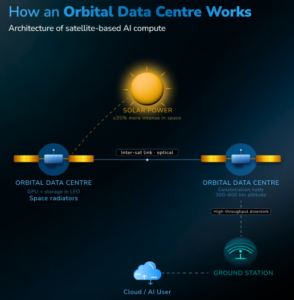
Satellites communicate using laser-based optical links, the space equivalent of fibre, passing data at near-fibre speeds between nodes. In November 2025, Starcloud launched the first Nvidia H100 GPU into orbit aboard a SpaceX Falcon 9. By December, that chip had trained NanoGPT on the complete works of Shakespeare, the first language model trained in space. The engineering foundation has been proven. What remains is scaling it.
3. The Case for Orbit: Solar Power, Zero Water, Unlimited Scale
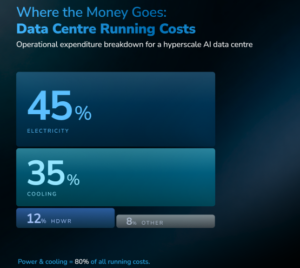
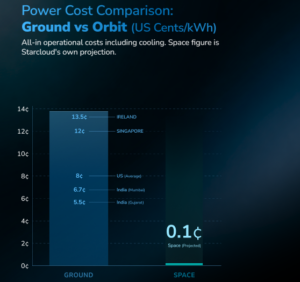
Power cost. Electricity is the single largest operating cost for a data centre, roughly 45% of all expenditure. In Mumbai, data centres pay around 6.7 US cents per kilowatt-hour. In Ireland or Singapore, over 12 cents. In orbit, solar panels generate electricity at effectively zero marginal cost. Starcloud’s white paper estimates the effective power cost at around 0.1 US cents per kilowatt-hour, roughly 95% cheaper than the cheapest terrestrial market. Note: this is Starcloud’s own projection, not an independently audited figure.
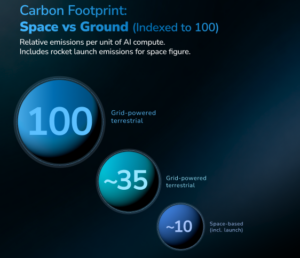
Water and carbon. A space data centre uses zero water. The vacuum of space handles cooling passively. Starcloud estimates orbital computing produces roughly 90% fewer carbon emissions per unit of AI compute than a standard grid-powered data centre, even accounting for rocket launch emissions.
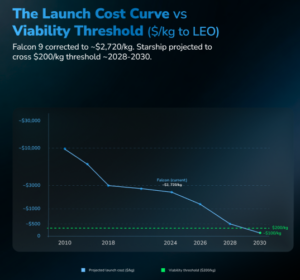
Scalability. On Earth, every new data centre requires land, planning approvals, grid connections, and years of construction. In orbit, the constraint is simply launch capacity. Launch costs are falling fast. As SpaceX’s Starship reaches full operational cadence, the cost of putting a kilogram into orbit is expected to fall from today’s ~$2,720/kg (Falcon 9 customer price) to under $300 by 2030, and potentially as low as $100/kg at full Starship scale. This is what makes the economics of orbital computing shift from premium niche to genuinely competitive.
Data sovereignty. India has made data localisation a policy priority. An orbital data centre on Indian-operated satellites provides a form of sovereignty that no onshore facility can fully guarantee against foreign legal instruments like the US CLOUD Act, which allows American courts to compel data from US-operated cloud providers anywhere in the world.
4. The Global Race: Who Is Building What
What makes this moment significant is the speed of convergence. Eighteen months ago, space data centres were white papers and investor pitches. Today, there is hardware in orbit, national programmes with real budgets, and filings with regulators for constellations of hundreds of thousands of satellites. The race has begun, and multiple countries understand the stakes.
This is not a single company’s moonshot. It is a multi-country infrastructure race with national strategic stakes. China already has a functioning orbital computing constellation. Three major US players have filed with regulators. Europe is spending €300 million to secure data sovereignty through orbit. And NVIDIA, the company whose chips power all of this, now ships hardware purpose-built for space. The question is no longer whether this happens. It is who leads it
5. What Could Go Wrong
The honest version of this story includes the obstacles, and they are real.
1. The Latency Problem
Even at LEO altitudes, data takes 2–4 milliseconds to make a round trip to a satellite and back. That sounds tiny, but real-time AI applications, live voice assistants, autonomous systems, live financial trading, require responses in under 10ms total. Space data centres are well-suited for AI training and batch processing, but they cannot replace edge computing for real-time use cases. This limits, but does not eliminate, the addressable market.
2. No Maintenance in Orbit
Once a satellite is launched, its hardware is fixed. You cannot swap a chip or upgrade a server. In a world where NVIDIA releases a new, significantly better GPU generation every 18 months, an orbital data centre faces rapid obsolescence with no remedy. The industry’s working solution is to treat orbital hardware as disposable, launch, use, deorbit, replace. This changes the capital model entirely, favouring low-cost, fast-iteration satellites over expensive long-lived ones.
3. The Space Debris Question
Earth orbit already contains approximately 27,000 tracked pieces of debris, fragments from old satellites, rocket stages, and collisions. Adding thousands of new data centre satellites meaningfully increases the risk of what scientists call Kessler Syndrome: a cascade of collisions that generates so much debris it makes entire orbital bands unusable, permanently. This is not hypothetical; it is a concern that regulators and space agencies are actively working on, but without yet having solved it.
4. Launch Costs Must Fall Further
Google’s feasibility study (Project Suncatcher, November 2025) placed the threshold for commercially viable orbital computing at $200 per kilogram to LEO. Today’s best price, using SpaceX’s Falcon 9, is around $1,500/kg. SpaceX’s Starship rocket, still in testing, is projected to reach $100/kg at full scale, potentially by 2029–2030. Until that happens, space compute remains a premium product suited to specific high-value workloads, not a mass-market alternative.
Latency constraints mean space data centres will serve AI training, batch processing, and sovereign data storage long before they challenge mainstream cloud infrastructure. The window for commercial viability at scale is 2028-2035. These are not reasons to dismiss the sector, they are the constraints that define who captures value, and when.
What This Means for You
Infrastructure has always preceded wealth creation. The families and businesses that understood railways in the 1870s, telecom in the 1990s, or cloud computing in the 2000s, not as speculative bets but as structural shifts in how the world would function, were the ones who positioned themselves ahead of the crowd. Space-based computing sits in that same category today.
For those who have built significant wealth in India, this story carries particular weight. The $90 billion committed to data centre infrastructure last year is already encountering the very constraints this issue describes. Power grids in Maharashtra and Karnataka are stretched. Water availability in Bengaluru is a genuine concern for site planners. None of these problems disappear with more capital. They are structural, and orbital computing addresses them structurally.
The investment question is not whether to put money into satellite companies. The more grounded question is: where does value accumulate as this shift unfolds? The clearest answer runs through the supply chain, Nvidia, launch infrastructure providers, publicly listed aerospace companies with declared orbital computing programmes, and increasingly, ISRO through private sector partnerships that did not exist five years ago.
The infrastructure being built today. on the ground and increasingly in orbit — will determine who controls AI’s computing capacity for the next 30 years. You do not need to invest in rocketry to benefit from this shift. But you do need to understand it.
Disclaimer
This article is for informational and educational purposes only and does not constitute investment advice, a solicitation, or a recommendation to buy or sell any securities or financial instruments. The information presented is based on publicly available sources as of the date of publication. Market conditions, regulations, and projections may change materially over time. Readers should conduct their own independent research and consult qualified financial and legal advisors before making any investment decisions. MintWit Financial Services and its authors accept no liability for actions taken based on this content.