
The investment landscape is shifting. The era of simple growth narratives is over. As AI reshapes industries and geopolitical tensions redraw economic maps, investors are demanding something different from the companies they back: resilience paired with relentless innovation.
PwC’s Global Investor Survey 2025 reveals a fascinating paradox. While fewer than one-third of investors expect robust worldwide economic growth in 2026, an overwhelming 92% are calling for companies to increase capital allocation toward technological transformation. This isn’t contradiction, it’s clarity. In uncertain times, innovation isn’t optional, it’s the only path forward.

For Indian HNIs and UHNIs navigating this landscape, the implications are profound. As India positions itself as the world’s third most attractive investment destination, understanding what global investors prioritize isn’t just about following trends, it’s about positioning your portfolio to capture the opportunities that others might miss.
This month, we explore what global investors are prioritizing in 2026.
We cover:
1. The new risk reality and why cyber threats top the list
2. Why AI isn’t optional anymore, it’s the competitive baseline
3. The transparency crisis between what investors want and what companies disclose
4. Why cross-sector players are winning over focused businesses
5. Where capital is flowing and what India’s #3 global ranking really means
6. How to position your portfolio for this innovation-driven environment
1. The New Risk Reality: What Keeps Global Capital Awake
Risk has taken on a different meaning in today’s markets. Traditional concerns such as regulatory shifts, political developments, or currency movements still matter, but they no longer dominate investor thinking. Instead, attention has shifted toward risks that can spread quickly across systems and sectors.
Cybersecurity sits at the centre of these concerns. As operations, supply chains, and customer interactions become increasingly digital, vulnerabilities in one area can rapidly escalate into broader business disruptions. Macroeconomic volatility and rapid technological change follow closely, reinforcing the reality that stability can no longer be assumed.

What stands out is how interconnected these risks have become. A cyber incident can undermine operational continuity, trigger market reactions, and weaken competitive positioning. Companies that treat such threats as isolated or purely technical issues are being viewed as structurally exposed.
Geopolitical tensions, while still relevant, rank lower than many expect. Investors appear to have adjusted to a world of ongoing geopolitical friction and are more focused on how well organisations respond regardless of external conditions. Environmental risks, too, are increasingly embedded into long-term planning rather than treated as short-term shocks.
For Indian portfolios, this shift provides a useful lens. Businesses that demonstrate strong governance, clear contingency planning, and the ability to operate through uncertainty are being rewarded. Resilience, in this context, is not about avoiding risk, but about maintaining performance when conditions are less forgiving.
In markets where uncertainty is persistent, the ability to absorb and adapt has become a source of competitive strength.
2. AI as the Competitive Baseline, Not a Differentiator
Few forces are reshaping business as rapidly as artificial intelligence. What was once viewed as an emerging capability is now an expected part of how companies operate and compete.
Investors are no longer impressed by limited trials or isolated use cases. The focus has shifted toward organisations that apply AI across functions, improving efficiency, sharpening decision-making, and enabling new revenue streams. The effects are already visible, with measurable gains in productivity, profitability, and top-line performance being reported across sectors.

For Indian companies, this represents both opportunity and pressure. The country’s deep technology talent and digital infrastructure offer a strong foundation, but legacy models built on incremental efficiency are under strain. Competing in an AI-driven environment requires more than automation; it demands rethinking how value is created and delivered.
Cost control remains an important starting point, particularly in competitive global markets. However, the longer-term advantage lies in using AI to enhance agility, responding faster to customer needs, optimising supply chains, and adjusting pricing or product strategies in real time.
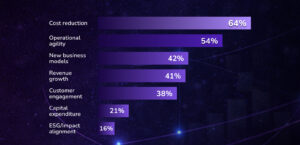
From an investment perspective, the distinction is becoming clearer. Businesses that can clearly link AI adoption to measurable outcomes stand apart from those relying on broad narratives. The question is no longer whether a company is using advanced technology, but whether it is changing how the organisation functions at its core.
As this transition accelerates, companies that delay or approach it superficially risk falling behind peers who are moving decisively.
3. The Transparency Gap: Why Disclosure Now Drives Valuation
As business models evolve more rapidly, investors are asking for greater clarity. One of the most consistent themes emerging from global surveys is the gap between what investors want to understand and what companies are willing to share.
This is especially evident in areas related to technology and transformation. While investors place high importance on understanding how these initiatives affect competitiveness and financial performance, many companies provide only limited or high-level information. The result is uncertainty, which markets tend to penalise.
For Indian firms, this challenge is particularly relevant. Conservative disclosure practices, once seen as prudent, are increasingly viewed as insufficient in a global context. Investors want detail, how much is being invested, how progress is measured, and how risks are managed.
Non-financial indicators are now feeding directly into valuation frameworks. Strategic clarity, governance quality, and execution discipline are influencing capital allocation decisions alongside traditional financial metrics. Companies that communicate these elements effectively often enjoy stronger investor confidence and more favourable valuations.
For investors, this reinforces the importance of asking sharper questions. Understanding strategy today requires more than reviewing financial statements. It involves assessing whether management teams can clearly explain how today’s investments translate into tomorrow’s returns.
In an environment defined by rapid change, transparency has become a competitive advantage rather than a regulatory obligation.
4. Cross- Sector Scale and Capital Allocation: The New Playbook
Another notable shift in investor preference is the growing appeal of businesses that operate across multiple sectors. This is not a blanket endorsement of diversification, but a recognition that value increasingly emerges where capabilities overlap.
Companies that expand thoughtfully into adjacent areas, leveraging data, infrastructure, or customer relationships, are often better positioned to capture growth and manage disruption. When executed well, this approach creates flexibility and reduces reliance on a single revenue stream.
This perspective aligns well with the structure of many Indian business groups, which have long operated across industries. What has changed is the emphasis on strategic coherence. Investors are favouring expansions that strengthen competitive positioning, rather than collections of unrelated assets.
Capital allocation patterns reinforce this view. There is strong support for directing resources toward technology, adaptability, and security, areas that underpin long-term relevance. Routine operational spending is assumed; transformative investment is where scrutiny and differentiation lie.

For management teams, this requires balance. Protecting existing businesses remains essential, but so does building capabilities that will matter in the future. Companies that allocate capital with a long-term perspective, while maintaining financial discipline, are better placed to navigate shifting market dynamics.
From an investment standpoint, this means looking beyond short-term earnings and evaluating how effectively capital is being deployed to support future growth.
Several factors underpin this confidence: favourable demographics, expanding digital infrastructure, improving market depth, and a more mature regulatory environment. Together, they create conditions that support both domestic expansion and global integration.

For Indian investors, this offers reassurance, but also introduces complexity. Increased international interest can drive valuations higher, particularly in well-covered sectors. Identifying opportunities therefore requires a more selective approach, focusing on businesses with strong fundamentals and room to scale.
At the same time, portfolios must reflect the interconnected nature of today’s markets. Domestic exposure remains important, but selective global diversification can help manage risk and capture opportunities arising from technological and structural shifts elsewhere.
The most effective strategies will be those that balance these dimensions—participating in India’s long-term growth while remaining adaptable to global developments.
Conclusion: Building Portfolios for a More Demanding Era
The signals from global investors heading into 2026 are consistent and compelling. Capital is gravitating toward companies that combine operational strength with the ability to adapt, supported by clear communication and disciplined execution.
For Indian investors, the environment presents both opportunity and responsibility. Structural tailwinds are in place, but capturing their full benefit requires a more thoughtful approach to evaluating businesses and allocating capital.
The companies likely to perform well in the coming years are those that can withstand disruption, evolve with changing conditions, and articulate their strategies with clarity. Portfolios built around such businesses are better positioned to deliver durable returns, even as uncertainty remains a constant feature of the landscape.
In this context, the guiding principle is straightforward: stability and progress are no longer opposing goals. They are increasingly two sides of the same coin.
Disclaimer
This article is for informational purposes only and does not constitute investment advice. Data referenced is sourced from PwC’s Global Investor Survey 2025. Market conditions may change. Readers should conduct independent research and consult qualified financial advisors before making investment decisions. Past performance does not guarantee future results.