
Luxury is shifting beyond products. It’s becoming about what matters, moments that feel personal and blend naturally into how people live and explore the world.
2025 has redefined what luxury truly means. It’s no longer measured by five-star ratings or first-class cabins, but by Pace, Privacy, and Personalization.
And this isn’t just a worldwide shift. India is fast becoming a travel powerhouse. The country’s luxury tourism sector, valued at USD 72.9 billion in 2024, is projected to reach USD 131.2 billion by 2030, expanding at a steady 10.5% CAGR. Behind this rise is a new wave of high-net-worth travelers: those who value tailored itineraries over mass tourism, distinctive moments over conventional comfort, and wellness-driven journeys over indulgent excess.
Indians, in particular, are fueling this trend, no nation’s outbound tourism sector is expanding faster. India’s outbound market is projected to reach USD 55.4 billion by 2034, growing at 11.4% annually. In response to this rapidly accelerating boom, Indian airlines placed orders for a staggering 1,359 aircraft in 2023 and 2024 combined, 999 in 2023 and 360 in 2024. Air India alone ordered 570 aircraft (initially 470 in 2023, plus 100 more in 2024), while IndiGo placed orders for 500 planes in 2023, representing the largest single aircraft order in commercial aviation history.
International travel is back and buzzing. Social feeds brim with excitement over sun-soaked EuroSummer escapes, while “coolcations” to chillier spots like Scandinavia, Iceland, Alaska, and Norway surge 89% in popularity. After the drastic 75% drop in 2020, travel rebounded strongly through 2023 and 2024, with 2025 marking a year of near-full recovery and record-breaking spending. Globally, the luxury travel market was valued at USD 239 billion in 2023 and is forecast to reach USD 391 billion by 2028. Every segment is expanding, indicating luxury travel is growing both upward (wealthier clients spending more) and outward (more people entering the sector). The rising tide is lifting all boats, creating opportunities across the spectrum, from “accessible luxury” to “money is no object” journeys.
This month, we explore Luxury Tourism in 2025. We cover:
1. How luxury travel evolved from status to substance..
2. Who’s driving the boom, and why the 40–60 age group dominates.
3. Where the wealthy are going, and what they’re truly seeking.
4. The trends shaping tomorrow’s journeys.
5. How India’s luxury scene is transforming, from palaces to purpose-driven escapes.
1. The Evolution of Luxury Tourism
High-end travel has quite a story. It started with Europe’s elite embarking on Grand Tours through France and Italy in the 1600s, think young aristocrats spending years absorbing art, culture, and wine. Then came the railways in the 1850s, and suddenly you could travel in style aboard the Orient Express. The early 1900s brought ocean liners like the Titanic (glamorous, if ill-fated), and by the 1950s Jet Age, the world’s wealthy were crisscrossing continents like it was nothing. Fast forward to the 1980s and 90s: globalization kicked in, iconic brands like Ritz, Savoy, and Four Seasons planted flags everywhere, and premium travel became less about exploration and more about lifestyle.
But here’s where it gets interesting. Somewhere along the way, luxury travel stopped being about how much and started being about how deeply. The private jets and butlers? Still there, but they’re no longer the point.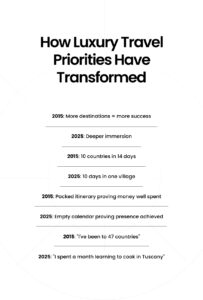 A decade ago, it was about status, scale, and showmanship, the kind that turned heads and filled feeds. Today, it’s about substance, reflection, and renewal: journeys that restore rather than impress.
The new calculus:
Destination × Depth × Discovery = Worth it.
2. Faces shaping luxury tourism
When we talk about high-end travel today, one question cuts through all the noise: who is actually spending the most? It’s not the Gen Z travelers hunting for the next viral reel in Santorini. It’s not even the silver-haired retirees finally cashing in their pensions for that dream cruise. The real architects of this explosive growth? The 40–60 age bracket.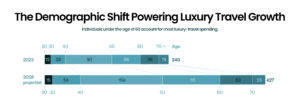 Look at the numbers. In 2023, this cohort alone spent $145 billion on leisure and hospitality, that’s over 60% of the entire $240 billion worldwide sector. By 2028, their share is expected to hit $270 billion, claiming nearly two-thirds of a $427 billion pie. That’s not just expansion, that’s dominance.
But here’s what makes this fascinating: why this group spends so differently. They’re in the sweet spot of life. Career peaks have been reached. Mortgages are manageable or paid off. Kids are either independent or old enough to travel meaningfully alongside them. The 40–60s have something rare: discretionary wealth meeting peak curiosity.
And here’s the kicker: they’re also funding family travel at scale. Multi-generational trips, bringing aging parents or adult children, are surging. These aren’t just vacations; they’re investments in family narrative.
McKinsey’s 2024 research reveals a critical shift: 35% of luxury travel spending now comes from “aspiring luxury travelers” with net worths between $100,000 and $1 million.These travelers, often younger, are willing to spend significant portions of their wealth on upscale experiences, even if they can’t afford luxury across every aspect of their trip.
In India, this mirrors perfectly. The 40–60 Indian high-net-worth traveler isn’t just wealthy, they’re intentional. They’ve traveled enough to know what they don’t want (crowds, chaos, cookie-cutter itineraries). What they do want? Selective access. Deep cultural exchanges. Wellness-focused escapes. And increasingly, travel that reflects their values.
When money meets curiosity, the world becomes a playground.
3. Places shaping luxury tourism
The emphasis on tailored itineraries isn’t just talk, the data backs it up beautifully. According to McKinsey, 81% of premium travelers chase new locations, 58% seek cultural depth, and 30% crave authentic engagement, proving that today’s high-end travel is about exploration, not decadence.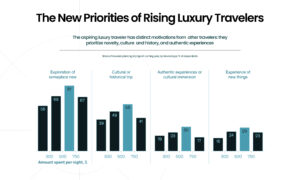 What this data reveals is a clear hierarchy of values: novelty first, culture second, authenticity third. These travelers aren’t running from their lives, they’re running toward transformation. The higher you move up the spending ladder (from $300/night to $750+), the more pronounced this shift becomes.
For Indian millionaires specifically, the map is both predictable and telling. Their top five locations are Singapore, the United Kingdom, Switzerland, France, and Greece.
These spots aren’t random. They check multiple boxes: ease of access, international prestige, cultural richness, and most importantly, they offer both business utility and leisure depth.
Meanwhile, emerging destinations are gaining traction. Seychelles saw a remarkable 115% increase in Indian visitors, while Vietnam experienced 50% growth. These numbers reflect Indians’ growing appetite for off-the-beaten-path luxury experiences.
4. Trends shaping luxury tourism
Here’s something counterintuitive: premium travelers still love the basics. Beach vacations and relaxing getaways remain king. On paper, they look almost identical to mass-market travelers, but that’s where the similarity ends. The high-end segment is re-engineering traditional locations with exclusivity and hyper-customization baked in.

So if the trip types overlap, what actually separates them from everyone else?
Specialty travel. That’s the tell.
This is where the gap becomes a chasm. Look at adventure and extreme sports: 35% of affluent travelers are planning these trips compared to just 15% of mass travelers.That’s more than double. High-net-worth individuals don’t pick either relaxation or adventure, they do both. Their travel isn’t linear; it’s layered. It’s travel as portfolio diversification.
What This Reveals About the HNI Mindset
First, they’re not abandoning the mainstream, they’re stacking on top of it.
Second, these travelers increasingly choose trips that demand physical skill and transform them, not just relax them.
Third, certain journeys, like safaris, yachting, and skiing, function as conversational currency and social positioning tools in elite circles.
McKinsey’s research shows that the luxury hospitality space is projected to grow at 6% per year through 2025, faster than any other travel segment. This growth is being driven by travelers who want experiences that blend adventure, wellness, cultural immersion, and Instagram-worthy moments.
At the end of the day, they aren’t just buying trips.
They’re buying versions of themselves they want to become.
5. Travel in India
Luxury travel in India is undergoing a deep and deliberate transformation, one that mirrors the country’s growing economic confidence and changing lifestyle aspirations. Once defined by five-star hotels, chauffeur-driven tours, and opulence for display, the Indian travel sector is now pivoting toward substance, exclusivity, and customization.
In 2024, India’s premium travel sector reached USD 72.4 billion, accounting for 4.9% of worldwide revenue, and it shows no signs of slowing. Indians now represent a sizable share of high-value international travelers, with both domestic and outbound bookings rising sharply.
The numbers are compelling:
– 37% of Indian travelers planned to upgrade to business or first class in 2024
– 44% opted for airport lounge access, underscoring a growing appetite for comfort and convenience
– International hotel bookings surged 57% year-on-year, signaling strong willingness to spend on quality
– 81% of Indians now prefer luxury travel over traditional lavish weddings
This emotional evolution underpins the new wave: travel is now a preferred form of self-expression, wellness, and memory creation over conventional extravagance.
The Cultural Shift
The composition of travel itself is changing. Families are using it to celebrate milestones together, trading grand weddings for shared adventures across continents. This represents an 81% preference shift toward luxury travel over traditional lavish weddings, a remarkable cultural transformation indicating that travel has become the new status symbol.
Privacy and Selective Access
Privacy, once a fringe preference, is now a hallmark of Indian high-end tourism. Private villas, boutique resorts, and heritage palaces in quieter locales are seeing unprecedented demand. Rather than seeking extravagance, travelers are seeking selective access.
This preference isn’t limited to outbound tourism. Domestic spots such as Rajasthan, Kerala, Ladakh, and the Andaman Islands are now being reimagined as world-class escapes. Internationally, new locations favored by wealthy Indians include Seychelles (+115% visitor rise) and Vietnam (+50%).
In essence, high-end travel in India today is no longer about showing the world you can afford it, it’s about traveling in a way that reflects who you are. It’s about journeys that enrich, restore, and reconnect: a lifestyle defined not by price tags, but by intent.
5. Conclusion: The Future of Luxury Travel
The transformation of luxury tourism from conspicuous consumption to conscious exploration represents more than a market shift, it signals a profound evolution in human values. As we’ve seen, the $391 billion global luxury travel market by 2028 isn’t just about money changing hands; it’s about travelers seeking transformation, not just transportation.
The market dynamics are clear: India’s 10.5% CAGR in luxury tourism outpaces most developed markets, positioning the country as a critical player in the future of high-end travel. The 40-60 age demographic, commanding over 60% of global luxury travel spending, will continue to drive innovation in personalized experiences.
The paradigm has shifted: Luxury is no longer about gold-plated fixtures or Michelin stars alone, it’s about the depth of experience, the authenticity of connection, and the lasting impact of the journey. McKinsey’s data showing 81% of premium travelers prioritizing new locations over familiar luxury demonstrates this fundamental reorientation.
The opportunity is immense: For destinations, hospitality providers, and travel companies, the message is clear, invest in experiences that transform, not just impress. The aspiring luxury segment (35% of the market) represents untapped potential, while the established HNI segment demands ever-more sophisticated, purpose-driven offerings.
As we look ahead, luxury tourism will continue to evolve toward sustainability, wellness, and cultural authenticity. The travelers who once sought to display their wealth now seek to invest it in experiences that enrich their lives, strengthen family bonds, and create lasting memories. In 2025 and beyond, the true luxury isn’t the destination, it’s the transformation that happens along the way.
Disclaimer
This article is for informational purposes only. All data and statistics are as of November 2025 and sourced from McKinsey & Company, industry reports, and publicly available sources. While efforts have been made to ensure accuracy, we do not guarantee completeness or suitability for any specific purpose. References to destinations, companies, or brands are illustrative only and not endorsements. Readers should conduct their own research before making decisions.