
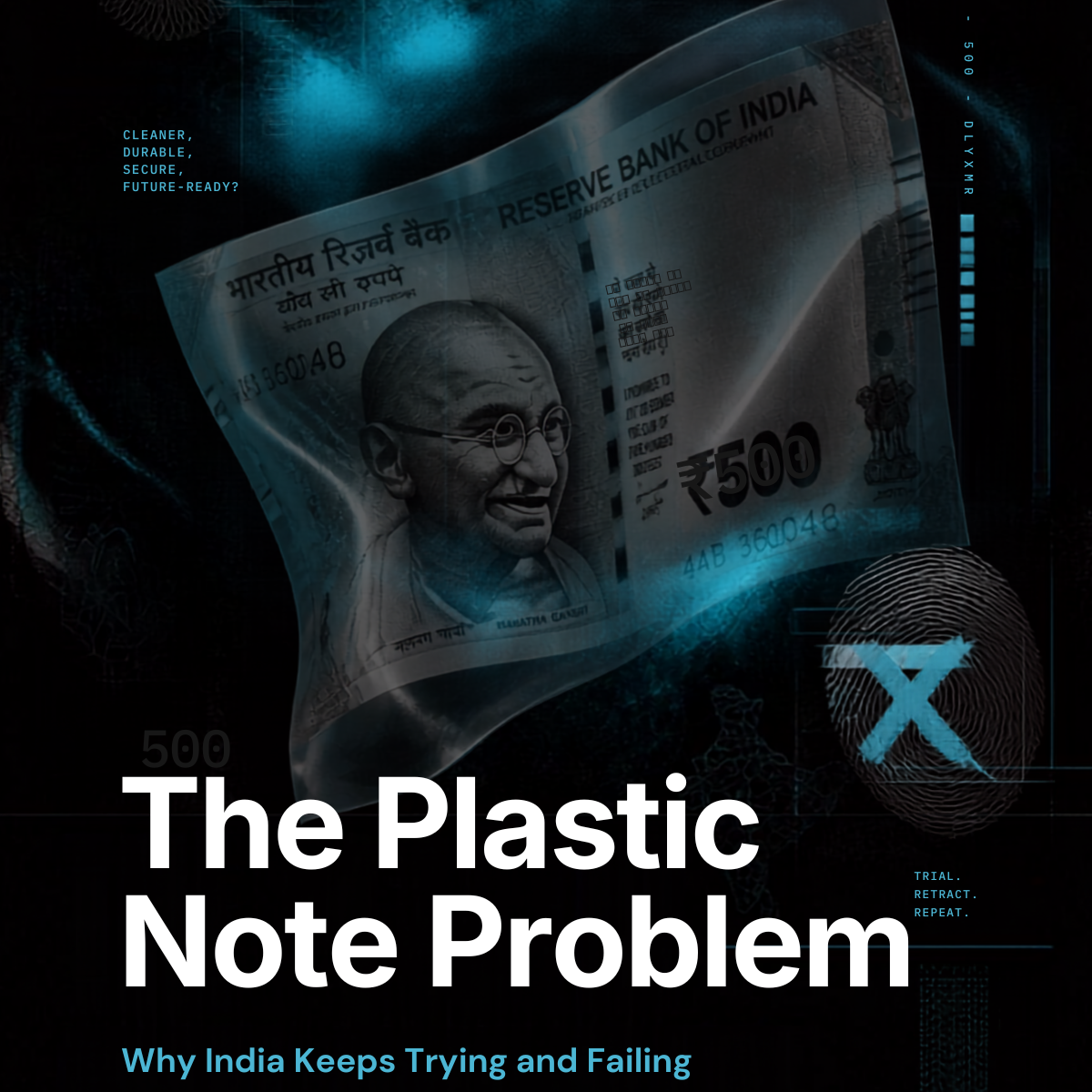
Every few years, the RBI floats the same idea. Move India’s currency from paper to polymer. Every few years, the idea quietly disappears. In 2026, the RBI is reportedly gearing up for fresh field trials of plastic notes. Before you assume your wallet is about to go plastic, here is why this story has repeated itself for over a decade, and why it might not end differently this time either.
- A Short History of a Long-Delayed Idea
- The Real Cost of Paper: What the RBI Spends Every Year
- Billions of Notes, Thrown Away
- The Case for Plastic: Why It Sounds Like a No-Brainer
- The Bottleneck Nobody Talks About: Material, Not Money
1. Third Time’s the Charm?
India’s polymer note story did not begin in 2026. It began in 2009, when the RBI first ran pilot projects to test plastic currency. That attempt did not go anywhere. In 2012, the idea resurfaced. Polymer notes were approved for a trial in a handful of cities. That attempt failed too. In 2016, the RBI tried again. Same result.
Now, a decade later, the RBI is preparing for another round of field trials. Which raises an obvious question for anyone tracking this space. If the idea failed twice already, what makes 2026 different?
The honest answer is that nothing structural has changed yet. The core problems that derailed the earlier attempts, mainly ATM compatibility and import dependence, have not been fully solved. What has changed is the pressure. Currency in circulation has climbed to a record rupees 42.97 lakh crore since 2017, and the volume of damaged notes being destroyed every year keeps growing. The RBI has more reasons to try again, but not necessarily more tools to succeed this time.
This history matters for anyone reading headlines about “India’s plastic currency” with excitement. The base rate for this specific policy idea in India is two failures out of two attempts. A third trial is worth watching, not betting on.
2. The Real Cost of Paper: What the RBI Spends Every Year
Here is the financial case that keeps bringing polymer back onto the table. Indian currency notes are printed on a blend of 75% cotton and 25% linen paper that can withstand roughly 4,000 double folds before it tears. In a country as densely populated and cash-heavy as India, that is not very long. Notes get soiled, torn, and pulled out of circulation constantly, and replacing them is not free.
Since the 2016 demonetisation, the RBI’s annual security printing expenditure has mostly stayed in the rupees 4,000 to rupees 5,000 crore range, with a few sharp spikes. FY17 saw costs jump toward rupees 8,000 crore because of the demonetised note replacement. FY24 and FY25 saw another climb, this time crossing rupees 5,000 crore and touching over rupees 6,300 crore, largely due to the rupees 2,000 note withdrawal. FY26 has settled back down closer to rupees 4,875 crore.
The pattern is consistent. Even in a “normal” year with no major currency event, India spends thousands of crores simply keeping paper money in circulation. That is the number the RBI is trying to bring down, and it is also the number that makes polymer notes, which reportedly last two and a half to four times longer than paper, worth a serious look.
For investors, this is a useful reminder that even something as basic as printing money is a budget line item with real fiscal weight, and one that shows up quietly in RBI annual reports every year.
3. Billions of Notes, Thrown Away
The scale of paper currency wastage in India is easy to underestimate until you see the number. Last year alone, India destroyed 23.8 billion damaged notes. Not lakhs, not crores of notes. Billion, with a b.
Each of those notes had to be collected, verified, shredded or recycled, and replaced with a freshly printed one. That cycle is where a large chunk of the RBI’s rupees 6,373 crore printing bill for FY25 actually goes. Paper money is comparatively cheap to make, but it is expensive to keep replacing at this frequency and this volume.
This is really the strongest argument in favour of polymer notes, stronger even than counterfeiting resistance or waterproofing. If a polymer note genuinely lasts three to four times longer than a paper one, the number of notes India needs to destroy and reprint every year could fall meaningfully. Fewer notes destroyed means lower printing costs, less currency logistics load on the RBI, and a smaller environmental footprint from cotton and linen sourcing.
The Bank of England’s own polymer £5 note reportedly has a 16% lower carbon footprint than its paper predecessor, largely because it does not need to be replaced as often. Scale that logic to a country processing tens of billions of notes a year, and the potential savings, both financial and environmental, start to look significant.
4. The Case for Plastic: Why It Sounds Like a No-Brainer
On paper (pun intended), polymer currency checks almost every box a central bank would want.
It lasts longer than cotton-linen paper, standing up far better to daily handling, folding, and general wear. It is largely waterproof, which matters enormously in a country where currency regularly survives monsoons, sweat, and the occasional washing machine mishap. It is harder to counterfeit, because polymer film is naturally transparent, allowing a genuine see-through security window that cannot be replicated by scanning or photocopying. And over the note’s lifetime, it works out cheaper to maintain, because the RBI is not reprinting it every few years.
More than 60 countries have already made the switch, including Australia, Canada, and the United Kingdom. Australia was the pioneer, issuing the world’s first polymer banknote back in 1988. The UK completed its own transition as recently as 2022.
So if more than 60 countries have figured this out, and the financial case is this compelling, the obvious question is why India has not simply followed suit. That question brings us to the actual obstacle, and it has very little to do with whether polymer notes are a good idea.
5. The Bottleneck Nobody Talks About: Material, Not Money
The real challenge is not whether polymer notes are worth adopting. It is whether India can actually produce them at the scale a country of 1.4 billion people would require.
India can print paper currency domestically without much difficulty. Security-grade polymer substrate is a different story entirely. That specialised film is not ordinary plastic. It takes years of research and precision manufacturing to develop, and the global market for it is dominated by a small number of players, including Australia’s CCL Secure and Britain’s De La Rue. CCL Secure’s GUARDIAN substrate, the material used in the world’s first polymer note, took nearly two decades to perfect and is still used by more than 40 countries today.
India is, notably, the world’s second-largest producer of BOPP films, the base material used in polymer notes. But producing BOPP film at industrial scale is not the same as producing security-grade banknote substrate with the durability, security features, and consistency a central bank requires. Building that capability domestically is not something that happens in one budget cycle.
Then there is the infrastructure problem that sank the RBI’s earlier attempts. Polymer notes are more slippery than paper, which makes them harder for ATM rollers to grip and dispense reliably. This was the exact issue that derailed India’s pilots after 2009. The UK’s experience shows just how expensive fixing this can get. After introducing its first polymer note in 2016, the UK spent more than £45 million upgrading cash vending machines alone. Add cash-counting machines, and the total bill reportedly rose to nearly £240 million, or close to rupees 4,300 crore in today’s terms, for a country with a fraction of India’s currency volume and ATM network.
India could sidestep some of this cost by rolling out polymer only for small denominations like rupees 10 and rupees 20 notes, which change hands more frequently and would benefit most from added durability. But the rupees 500 note remains the most widely circulated denomination in the country, followed by the rupees 10 note, and the government is separately planning to expand ATMs that dispense smaller denominations given the ongoing crunch of small notes. That means any serious transition still requires upgrading a large share of India’s cash-handling infrastructure, not just a corner of it.
Add to that a smaller, almost trivial-sounding complaint. Polymer notes do not fold as easily as paper, so they do not sit comfortably in a pocket the way a crushed paper note does. It sounds minor, but user habit is a real factor in whether a currency change sticks.
What’s In It For You
For everyday transactions, nothing changes yet. This is a field trial, not a rollout, and India’s track record on this specific reform is two attempts, two failures. If the RBI is serious this time, watch for two signals rather than headlines: whether India starts building or importing security-grade polymer substrate at meaningful scale, and whether there is visible investment in ATM and cash-machine upgrades. Without both, a third pilot is likely to end where the first two did.
The more durable takeaway for investors is the reminder that even routine government operations, like printing currency, carry real fiscal costs that show up in budgets and RBI reports year after year. Tracking where that spending rises or falls can be a small but useful signal of broader operational and cost discipline within India’s financial system.
Disclamer- This content is for informational and educational purposes only and does not constitute investment, legal, or tax advice. Please consult qualified professionals before making any financial decisions. MintWit Financial Services LLP is an AMFI-registered Mutual Fund Distributor (ARN-283168); however, all investments are subject to market risks and returns are not assured.