
For most of 2025, the President of the United States could impose sweeping tariffs with a phone call and a press release. On February 20, 2026, the Supreme Court ended that era in a 6–3 ruling. What followed was a weekend of fury, improvisation, and a new legal architecture built at speed.
On February 20, 2026, the U.S. Supreme Court delivered a decision that instantly altered the legal foundations of American trade policy. In Learning Resources, Inc. v. Trump, the Court ruled 6–3 that the President may not rely on the International Emergency Economic Powers Act (IEEPA) to impose broad, sweeping tariffs.
Within hours, the administration signed a new tariff order under a different statute.
The rate changed marginally.
The authority changed completely.
And that distinction, authority over percentage, defines the next phase of U.S. trade policy.
This week we cover
1. The Escalation Phase: How Emergency Tariffs Took Hold
2. The Constitutional Reset: The 6–3 Supreme Court Ruling
3. The Three Statutes Now Defining U.S. Trade Policy
4. Country-Level Impact — India First
5. The Global Recalibration: EU, China, and USMCA Partners
1. The IEEPA Era: Speed Without Congress
IEEPA, the International Emergency Economic Powers Act of 1977, was built for sanctions, asset freezes, and emergency transaction controls. It was never meant to be a tariff machine. But early 2025, the Trump administration made it exactly that, using the law’s language allowing the president to “regulate importation” as the legal basis for sweeping duties on nearly every country on earth.
The appeal was simple: IEEPA was fast, broad, and required no congressional vote. The administration imposed tariffs on Canada, Mexico, and China under so-called “fentanyl orders” in February 2025, then unleashed the global “Liberation Day” tariffs in April 2025, pushing rates on dozens of nations to historic highs, including a peak of 50% on Indian goods.
For nearly a year, the courts stayed their hands while appeals played out. The U.S. Court of International Trade ruled IEEPA tariffs illegal in May 2025. The Federal Circuit affirmed in August 2025, calling the tariffs “unbounded in scope, amount, and duration.” The Supreme Court agreed to hear the case in September 2025, with oral arguments on November 5, 2025.
By that point, IEEPA-based tariffs had collected an estimated $160–175 billion from U.S. importers.

2. February 20, 2026: The Court Snaps the Lever
At 10:03 AM EST on February 20, 2026, the Supreme Court issued its decision in Learning Resources, Inc. v. Trump. Chief Justice John Roberts authored the majority opinion, joined by Justices Sotomayor, Kagan, Gorsuch, Barrett, and Jackson. Justices Thomas, Kavanaugh, and Alito dissented.
The core logic was constitutional: tariffs are taxes. The power to tax belongs to Congress under Article I. IEEPA’s grant to “regulate importation” does not, and cannot, include the power to raise revenue through duties. The word “tariff” appears nowhere in the statute.
Trump received the news via a handwritten note while meeting with governors at the White House. A governor in the room said he read it, muttered “that’s a disgrace,” and left. At his afternoon press conference, the president was sharper: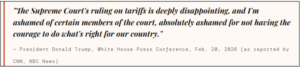
On Truth Social, Trump called the ruling “ridiculous, poorly written, and extraordinarily anti-American” and attacked two of his own appointees, Gorsuch and Barrett, who sided with the majority.

3. 10 → 15 → 10: The New Three-Lever Toolkit
Within hours of the February 20 ruling, President Trump signed a proclamation invoking Section 122 of the Trade Act of 1974 — a rarely used provision allowing a temporary import surcharge. The order imposed a 10% global tariff for 150 days, effective February 24, 2026. The following day, on Truth Social (Feb 21, 2026), Trump declared that the tariff would rise to 15% “effective immediately”, the legal maximum allowed under Section 122.
However, U.S. Customs and Border Protection (CBP) continued collecting 10%. Why? Because in U.S. trade law, Customs enforces only what is formally codified in the Federal Register and Customs instructions. The procedural steps necessary to activate 15% had not yet been completed.
In other words:
– The President announced 15%.
– The legal instrument still specified 10%.
– CBP collected what was legally active: 10%.
By February 24–25, officials confirmed the administration was still “working to implement” the 15% increase, but collection remained at 10%. This is not uncommon in trade policy: presidential messaging can move immediately; tariff implementation requires documentation, publication, and coding into customs systems.
Treasury Secretary Scott Bessent, appearing on multiple Sunday shows (Feb 23, 2026), framed this as part of a broader strategy. He described Section 122 as a “bridge authority” and made clear the administration would layer it with Section 232 and Section 301 if needed.
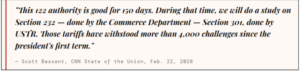 Bessent was equally blunt on revenue: “Treasury’s estimates show that the use of Section 122 authority, combined with potentially enhanced Section 232 and Section 301 tariffs will result in virtually unchanged tariff revenue in 2026.”

4. The $175 Billion Refund Question
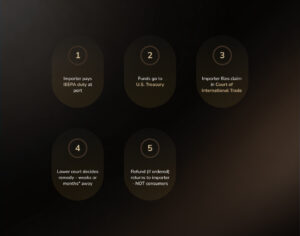
The Penn Wharton Budget Model estimates IEEPA-based tariff collections at approximately $175–179 billion through the ruling date, running at roughly $500 million per day. Every dollar of that sits in legal limbo. Over 1,400 companies, including L’Oréal, Dyson, and Bausch + Lomb, had already filed refund lawsuits before the ruling, a number expected to grow substantially.
The Supreme Court did not address refunds. That question was remanded to lower courts. Bessent was pointed in deflecting the political heat on CNN:

At the Economic Club of Dallas, Bessent was even more candid about the consumer outlook: “I got a feeling the American people won’t see it.” He called any payout “the ultimate corporate welfare,” since refunds, legally, flow to the importer of record, not to consumers who absorbed higher prices. (Fortune, Feb. 23, 2026)
UBS chief economist Paul Donovan echoed the point: refunds would act as fiscal stimulus for importers and “it seems unlikely anyone will rush to lower prices to their customers.”
5. Global Impact: A World Recalibrating
Every trading partner watching Washington is now asking the same question: which statute anchors the deal? The rate is almost secondary to the durability of the legal vehicle behind it.
India experienced the sharpest whiplash. After seeing tariffs hit 50% under IEEPA, a framework deal announced February 3, 2026 proposed cutting rates to 18%. Then IEEPA fell. India’s trade delegation delayed its February 23–24 trip to Washington for clarity. India’s trade minister said talks would resume once the new statutory framework was clearer. Section 122 took effect February 24 at 10%.
The EU pushed back with characteristic bluntness. The European Commission’s position after the ruling: “a deal is a deal,” arguing Washington should honor previously agreed terms. But the European Parliament’s trade committee paused ratification steps, and AP reported the EU suspended deal progress to await clarity on whether Section 122 exemptions would mirror IEEPA ones. The July 24, 2026 Section 122 expiry is the date Brussels is explicitly watching.
China said it was conducting a “full assessment” of the ruling through its Commerce Ministry, criticized unilateral tariffs, but left the door open: it said it was willing to hold another round of talks and would decide “in due course” on any countermeasures. Section 301 tariffs, the ones explicitly targeting China — remain fully intact.
Canada & Mexico are the relative winners, at least for now. USMCA-compliant goods remain largely shielded. Canada’s trade minister Dominic LeBlanc posted on X that the ruling “reinforces Canada’s position that the IEEPA tariffs imposed by the United States are unjustified.” Sector-specific tariffs on steel and aluminum remain, but North America is not playing the same game as everyone else.

6. The Bottom Line: It’s About Legal Durability, Not the Rate
The Supreme Court did not end tariffs. It ended one shortcut. The administration is now rebuilding the same economic pressure through a 150-day legal bridge (Section 122), while using that window to construct longer-lasting foundations via Section 301 and 232 investigations. Treasury is projecting zero change to 2026 tariff revenue. The refund battle, $175 billion in dispute, will play out in courts over months or years, with consumers almost certainly not seeing a dime. The real clock everyone should watch is July 24, 2026: the day Section 122 expires. Between now and then, the question isn’t what the rate is today, it’s which statute survives the next courtroom test.
Disclaimer
This newsletter is intended for informational and analytical purposes only and does not constitute legal, investment, or policy advice. All data is based on publicly available reporting and official announcements as of publication date. Legal outcomes, legislative actions, and trade measures remain subject to change.